
Why humanoid robots and physical AI could be tech’s next big thing
Payne Capital Management President Ryan Payne and market analyst Dan Geltrude discuss the AI boom, SpaceX’s IPO, Microsoft’s new coding model and OpenAI’s expansion on ‘Mornings with Maria.’
Although the artificial intelligence (AI) investment thesis is still young, some investors are already eyeing the next big thing in tech. They don’t have to look far, and the next big thing may actually be two things: humanoid robots and physical AI.
Fortunately, these aren’t daunting concepts. As the name indicates, humanoid robots are modeled after us and designed to work alongside us, performing basic functions to enhance productivity. Those robots are part of the broader physical AI landscape, which also includes various autonomous systems such as self-driving vehicles and surgical robots.
Experienced investors know there are plenty of robotics stocks and a fair number of exchange-traded funds (ETFs) focused on this theme. Still, when it comes to an emphasis on humanoid robotics, the KraneShares Global Humanoid Robotics and Physical AI Index ETF is the ETF to consider.
HOW ETFS CAN BE EFFECTIVE BUILDING BLOCKS FOR RETIREES
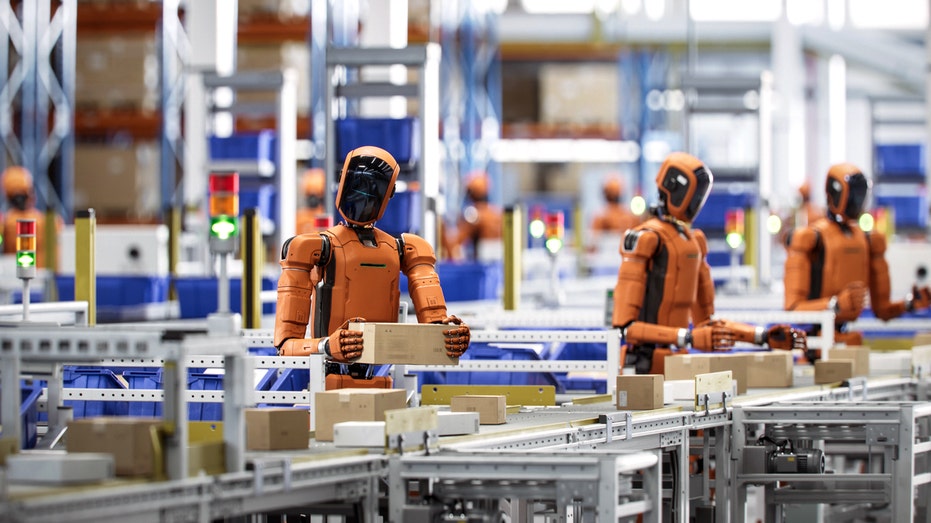
Humanoid robots are part of the broader physical AI landscape. (Getty Images)
A young ETF asserting itself
This robotics fund, which tracks the MerQube Global Humanoid and Embodied Intelligence index, is the first ETF of its kind to trade in the U.S., and it has a first-mover advantage. Investors like that, along with the fund’s purity because it turns a year old on June 4 and already has $241 million in assets under management (AUM).
WHAT ARE ACTIVE ETFS AND HOW ARE THEY RESHAPING HOW AMERICANS INVEST?
Year-to-date inflows of $89 million bolster that tally, confirming that investors see opportunity with this next-generation tech ETF. Understandably, they feel that way because the KraneShares fund could reward long-term investors. Morgan Stanley estimates that the humanoid robotics market could be worth $5 trillion by 2050.
| Ticker | Security | Last | Change | Change % |
|---|---|---|---|---|
| KOID | KRANESHARES TRUST GLOBAL HUMANOID ROBOTICS | 42.30 | -0.42 | -0.98% |
Perhaps underscoring the case for taking the long view with this ETF is the fact that humanoid robots are currently expensive. Still, prices are forecast to decline, which should spark increased adoption. Two years ago, one humanoid robot cost $200,000. That’s the price of a house in some places; Morgan Stanley sees that price falling to $150,000 in 2028.
As investors already learned with “old guard” AI stocks, adoption trends and the emergence of more real-world uses are crucial to the humanoid robotics/physical AI theme. Stock-picking to that effect can be tricky even for highly seasoned investors, highlighting why some are embracing this ETF.
US ETF ASSETS UNDER MANAGEMENT TO MORE THAN DOUBLE TO $25T BY 2030, CITIGROUP SAYS

At the sector level, robotics stocks span multiple sectors. (Spencer Platt/Getty Images)
The ETF’s fine points
It’s worth noting that, at the sector level,…
Read More: Why humanoid robots and physical AI could be tech’s next big thing