
Relics Of A Revolution, Part II: False Profits And Freedom
Revolutions leave behind artifacts — not always weapons or flags, but the quieter objects that carried a message before anyone knew how far it would travel. A wheat-pasted broadside on a Los Angeles overpass. A hand-lettered cardboard sign held up in the snow outside a Tokyo office building. A newspaper headline, pulled from the front page of The Times of London and encoded permanently into a piece of software that would go on to challenge the architecture of global finance.
The works gathered in Relics of a Revolution at the Bitcoin 2026 Conference in Las Vegas trace a specific lineage of dissent — one that connects street-level protest to the birth of Bitcoin itself. Mear One (b. 1971, Santa Cruz, CA) has spent nearly four decades using the walls of Los Angeles as a medium for political and economic confrontation. He pioneered the Melrose graffiti art movement in the late 1980s, was the first graffiti artist to exhibit at the 01 Gallery on Melrose and at 33 1/3 Gallery in Silverlake — where Banksy would later debut his first North American show — and in 2004 joined Shepard Fairey and Robbie Conal on the Be the Revolution tour, a nationwide series of anti-war street art interventions during the Bush administration. His work was part of the landmark Art in the Streets exhibition at the Los Angeles Museum of Contemporary Art in 2011 and resides in the permanent collections of the Laguna Art Museum among others. From anti-Gulf War broadsides in the early 1990s through the Occupy Wall Street encampments of 2011, Mear One has been making work that insists the root problem is the system itself — not the politicians or the policies, but the underlying architecture of money and power.
I sat down with Mear One ahead of his panel at Bitcoin 2026 to talk about protest, art, broken systems, and why the revolution is not over, or how to exit a loop.
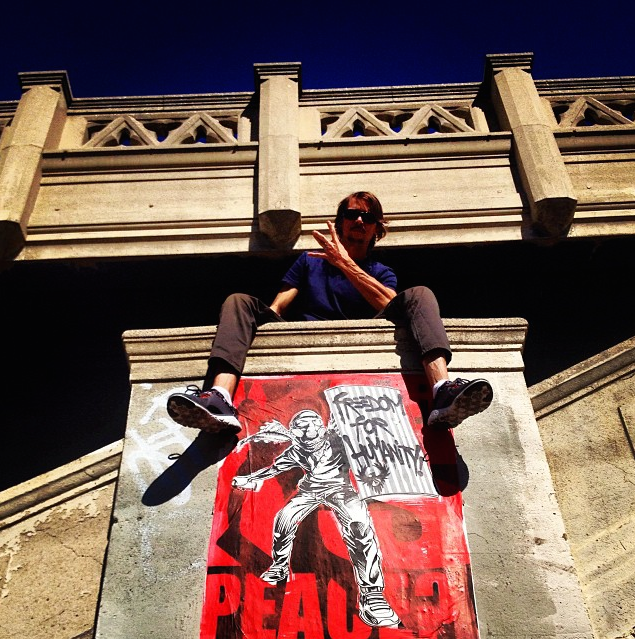
BMAG: Mear One, you started writing on walls in Los Angeles in the mid-1980s, at a moment when graffiti was still broadly criminalized and the idea of it entering museum collections would have seemed far-off. By the early 1990s, you were making large-scale political work — anti-Gulf War broadsides, pieces confronting economic power structures head-on. What was driving you to use the street as a political medium at that point, and who were you trying to reach?
Mear One: Graffiti is the voice of the dissatisfied soul, and back then it was a vehicle to reach the masses before the internet took off & social media ever existed. When you illegally spray paint your ideas in the public realm it resonates with the urbanite caught in traffic, angers the city officials whose dilapidated walls we scribe like a big middle finger to their failed policies. Conscious art speaks to conscious people, and the act of vandalism carries with it an energy that helped instigate a movement which was lacking. The streets were our meeting ground, and getting away with it kept us all anonymous,…
Read More: Relics Of A Revolution, Part II: False Profits And Freedom