
Nickel Price 2025 Year-End Review
After peaking above US$20,000 per metric ton (MT) in May 2024, nickel prices have trended steadily down.
Behind the numbers is persistent oversupply driven by high output from Indonesia, the world’s largest nickel producer.
At the same time, demand from China’s manufacturing and construction sectors, traditionally large consumers of stainless steel, has been weak as the country’s beleaguered real estate sector continues to find its footing.
Read on to learn what other key factors moved the nickel sector in 2025.
Nickel price in Q4
At the start of the fourth quarter, the nickel price was little changed from Q3, essentially trading in the US$15,000 to US$15,500 range. That’s the same level it had been at since April’s post-“Liberation Day” base metals market rout, which sent nickel spiraling to a year-to-date low of US$14,150.
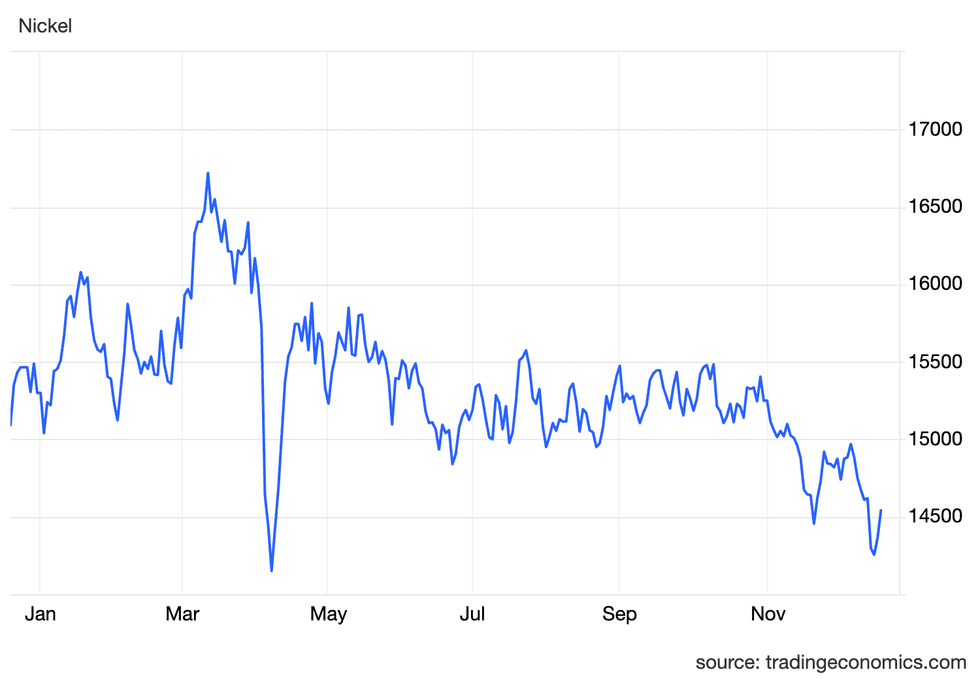
Nickel price, December 19, 2024, to December 18, 2025.
Chart via TradingEconomics.
Cracks began to form at the end of October as it became clearer that the oversupply situation was likely to persist, pushing nickel back below the US$15,000 mark by mid-November. The price rebounded in late November, but failed to break US$15,000 again and slid toward a yearly low, reaching US$14,235 on December 15.
Oversupply continues to weigh on nickel
At the end of Q3, the expectation was that nickel prices would gain momentum as the monsoon season arrived in the Philippines; however, despite seasonal declines in output, the market ‘s supply glut persisted.
As of September 30, London Metal Exchange (LME) warehouses held 231,504 MT of nickel, and by November 28, stockpiles had grown to 254,364 MT, nearly 100,000 MT higher than the start of 2025.
According to a mid-December Shanghai Metals Market article, refined production decreased by 25,800 MT in November. Still, it was outpaced by inventory accumulation as downstream demand remained soft.
On the demand side, stockpile buildups coincided with the traditional off season for stainless steel producers, which account for 60 percent of total nickel demand, and weak end-use consumption led some producers to initiate output cuts. Additionally, Shanghai Metals Market notes that stainless steel demand was further impacted by the superior economics of recycled materials. The outlet also states that although production costs in Indonesia are lower than they are elsewhere, the price of nickel is rapidly approaching producers’ breakeven point.
In February, the Indonesian government changed its quota system, increasing nickel ore output to 298.5 million wet metric tons, up from 271 million wet metric tons in 2024. The move from the top nickel producer was designed to alleviate supply pressures, with increased production limited to major production areas.
This was followed in October by a change to the length of time production quotas are valid, shortening it to one year…
Read More: Nickel Price 2025 Year-End Review