
From Data to Discovery: How AI is Changing the Face of Modern Mining
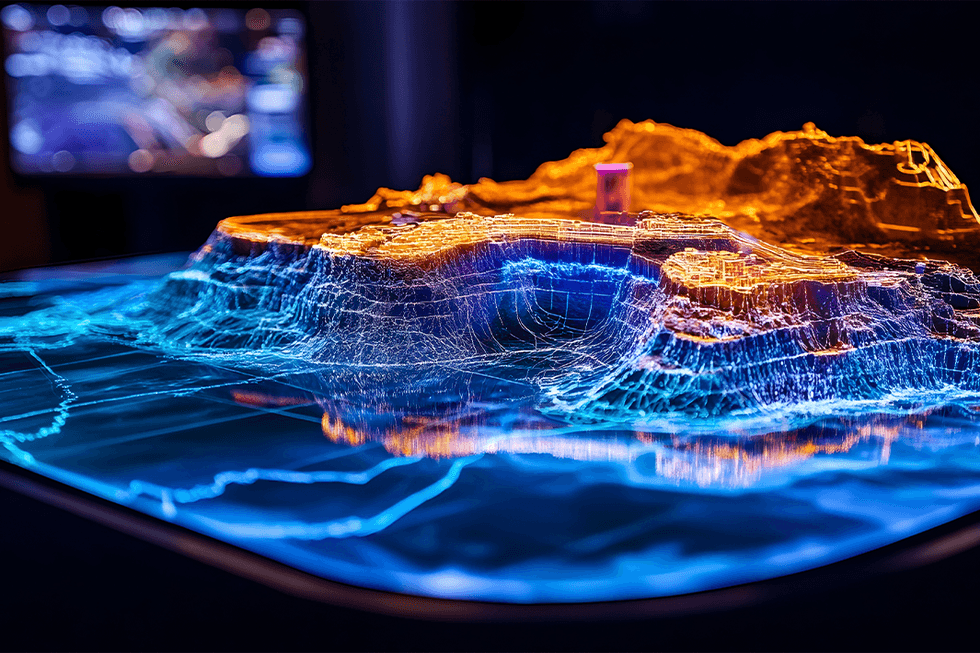
Mineral exploration is one of the riskiest and most capital-intensive phases of the mining lifecycle. The process has traditionally relied heavily on historical geological records, field surveys and extensive drilling, often with low success rates and long time horizons. But a new wave of digital innovation is reshaping the landscape.
Artificial intelligence (AI) and advanced data analytics are increasingly at the forefront of a quiet revolution in mining, offering tools that enhance discovery potential, reduce exploration risk and deliver stronger returns for investors.
Historically, mineral exploration has been marked by high uncertainty and significant financial risk. Companies spend millions of dollars poring over old geological maps, conducting labor-intensive fieldwork and drilling test holes — all in hopes of finding an economically viable deposit. In fact, industry data suggests that only a tiny fraction of exploration projects — approximately one in a thousand — ever reaches production. This low success rate has often made early-stage mining investments difficult to assess and even harder to justify without deep technical insights or a strong appetite for risk.
Rise of AI in mineral exploration
The advent of AI is beginning to change that equation. Modern machine learning models can ingest and process enormous volumes of geological data — from drill results and geochemical assays to satellite imagery and structural maps — and identify patterns that point to high-probability mineral targets.
These models are capable of recognizing subtle correlations and anomalies that are invisible to the human eye, allowing exploration teams to focus their efforts with far greater precision.
By streamlining the target identification process, AI helps companies reduce the number of costly and unnecessary drill holes. It also shortens the time required to move from early-stage exploration to resource definition, effectively compressing development timelines. In several recent cases, AI-driven platforms have already demonstrated their value by uncovering mineralized zones that traditional methods had missed.
Big data and remote sensing: A powerful combination
The power of AI is amplified when it’s paired with modern remote sensing technologies. Satellite imaging, hyperspectral analysis, and airborne geophysics now allow companies to gather detailed geological information over vast areas — often without setting foot on the ground. These tools produce high-resolution data layers that feed directly into AI models, making them even more accurate and informative.
Real-time data processing capabilities also mean that exploration teams can adjust their models and decision-making as new information becomes available. This dynamic approach not only improves accuracy but also reduces the time and resources spent on ineffective…
Read More: From Data to Discovery: How AI is Changing the Face of Modern Mining