
Decentralized Money Didn’t Come From Nowhere
Bitcoin is a financial tool born of code and cryptography. But seen in a wider frame, it belongs to a cultural lineage more than a century old. Since the 1910s, avant-garde movements have probed questions that later became central to Bitcoin: Who decides value? Can rules replace rulers? How do systems record time, distribute trust or resist authority? Far from appearing out of nowhere in 2009, Bitcoin crystallized ideas that had long circulated in artistic experiments.
You don’t need to like art — or on-chain art — to follow this argument. This article is not a case for “Bitcoin art” but for understanding Bitcoin’s conceptual prehistory. If you are a Bitcoin maximalist, read what follows as the backstory of your protocol’s worldview, not an art-world detour. And if you are an on-chain maximalist, remember that maximalism of any kind denies reality: The logic of Bitcoin was not born on-chain.
Artists tend to surface and stress-test ideas before society at large absorbs them. What they explore in canvases, instructions, networks or number systems often migrates years later into economics, engineering and politics. The point of this article is not to conflate art with Bitcoin, but to show that Bitcoin is the cultural consequence of ideas rehearsed for over a century — ideas about decentralization, protocol, time and value that were already in the air long before they were established in code.
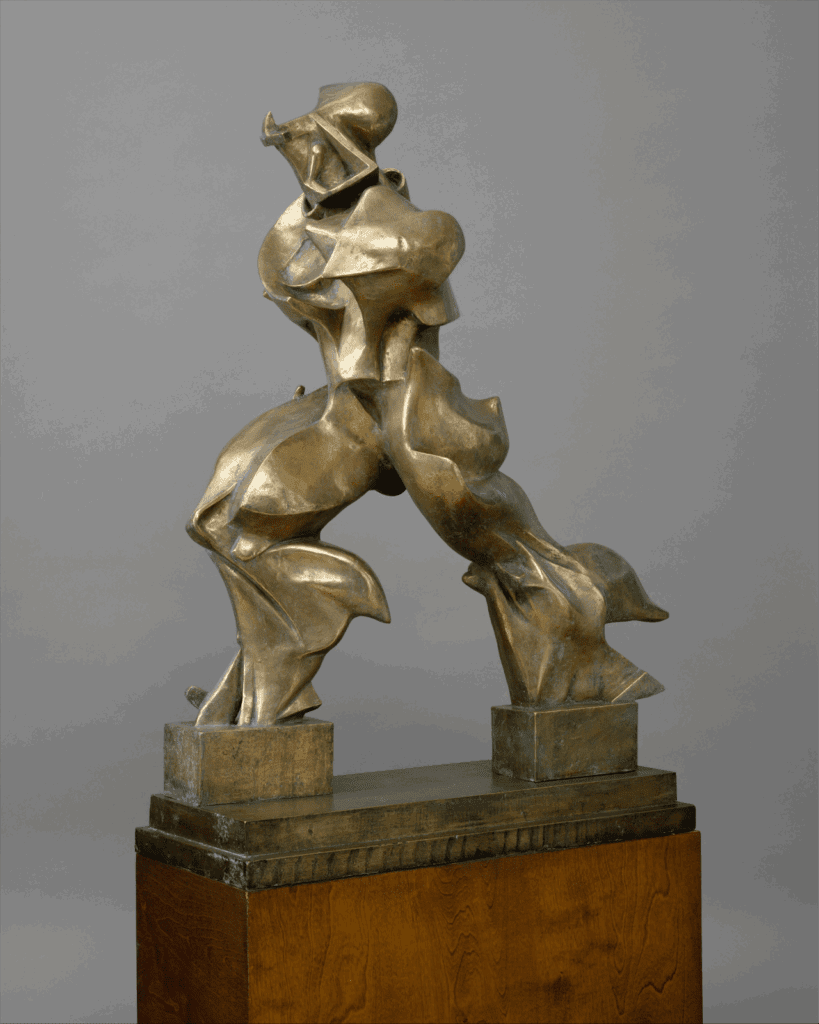
Avant-Garde Futurism: Speed, Systems and the Machine Aesthetic
If the early 20th century’s avant-garde had a launchpad, it was Italian Futurism. Announced in 1909 on the front page of Le Figaro by Filippo Tommaso Marinetti, the movement exalted “the beauty of speed,” the dynamism of the industrial city and the power of engines, aircraft and modern weapons. It called for the destruction of museums and libraries in favor of an aesthetic reboot — art in step with the machine age.
Futurist painters like Giacomo Balla and sculptors like Umberto Boccioni sought new visual strategies to capture motion: blurred outlines, repeated forms and “lines of force” that rendered figures as vectors in a dynamic system. Boccioni’s iconic “Unique Forms of Continuity in Space” (1913) depicts a striding figure whose body is broken into aerodynamic planes — more like a fluid diagram than anatomy. In sound, Luigi Russolo’s “Intonarumori” (noise intoners) brought the clang of factories and the churn of engines into orchestral performance, turning music into a mechanical event.
Futurism’s legacy is complicated — Marinetti’s later alliance with Italian fascism casts a shadow — but the movement planted seeds of a mindset crucial to later art and to Bitcoin alike: art as the design of systems, not just objects. The Futurists embraced rhythm, repetition, serial processes and the deliberate use…
Read More: Decentralized Money Didn’t Come From Nowhere